

How it works
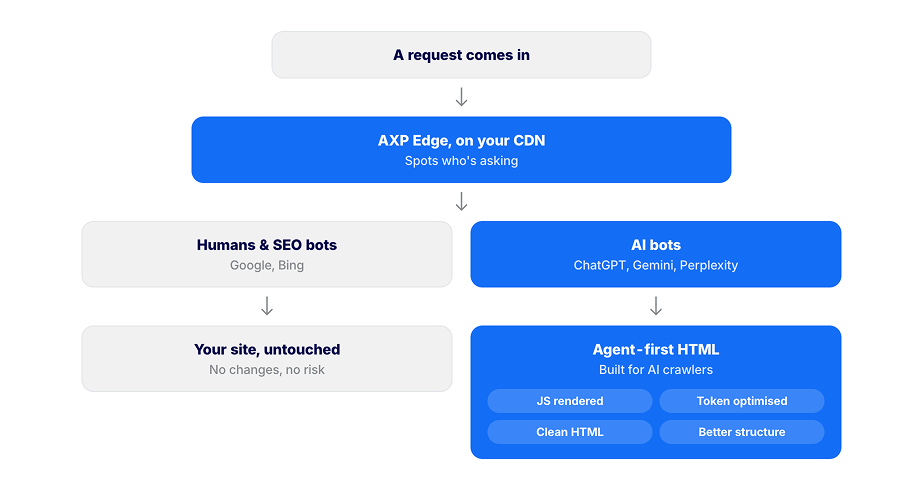
- Humans and SEO bots pass straight through to your site, byte-identical to what they get today. Nothing about your site, SEO, or user experience changes.
- AI agents (ChatGPT, Gemini, Perplexity, and similar) receive a JS-rendered, token-optimized version of the same page: no navigation chrome or scripts, just the structured content an AI agent needs to read and cite.
Not cloaking
AXP Edge only cleans up and restructures content that’s already on the page. It doesn’t show AI agents anything different in substance from what a human sees. Cloaking, by contrast, serves search engines different content to manipulate rankings. AXP Edge serves AI agents the same facts, in a form they can actually parse.Search engines like Google and Bing are treated the same as human visitors. They receive your normal pages, so your existing SEO is unaffected.
What changes for AI agents
Brands running AXP Edge on already-indexed pages have seen roughly 15-20% more AI citations from the same underlying content, simply because it becomes easier for an AI agent to parse and trust.
Enterprise-safe by design
- Nothing changes for customers: only AI tools receive the cleaned-up version.
- It stays on your own domain: there’s no second page to manage, and citations point back to your real URL.
- It fails safe: if the edge layer is ever unavailable, requests fall straight back to your normal origin.
Next steps
Getting started
Connect your CDN and go live in under two hours.